Bridging Training and Technical Assistance with Ancestral Roots: A Journey to Burney Falls
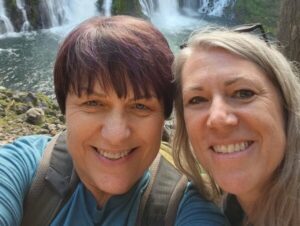
The American Indian Vocational Rehabilitation Training and Technical Assistance Center (AIVRTTAC) recently conducted an onsite Intensive Training and Technical Assistance (ITTA) site visit that underscored the profound connection between tribal vocational rehabilitation services and the Native land. Rebecca Holland, AIVRTTAC Vocational Coordinator, Sr., and Kimber Olson, AIVRTTAC Content Expert, had the honor of being hosted by the Pit River TVR Program for a journey into the heart of their ancestral grounds.
While the primary focus of ITTA is to provide specialized support and guidance to Tribal VR projects, the true benefit of these visits often transcends technical checklists. By being physically present in tribal communities, AIVRTTAC staff can witness the unique environments in which these programs operate. For the Pit River Tribal VR Program, this means navigating a landscape defined by its breathtaking remoteness and immense natural beauty.
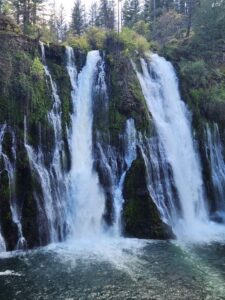
A highlight of the visit was a tour of Burney Falls, a place of deep cultural significance. Standing before the powerful, moss-draped cascades, it was impossible not to feel the weight of history and the spiritual importance of the land. AIVRTTAC staff do not take these invitations lightly; it is a rare privilege to be invited into these sacred spaces and to learn about Native traditions and cultural ways that many others never experience.
The emotional journey through the Forrest provided a vivid reminder that vocational rehabilitation in a tribal context is not just about employment outcomes; it is about honoring the whole person within the context of their community, culture, and heritage. The lush greenery, the crystal-clear waters of the river, and the snow-capped peaks watching over the territory served as a backdrop for deep learning and professional exchange.
We wish to extend our deepest gratitude to the Pit River TVR staff for their incredible hospitality. Their willingness to share their community, their time, and their culture allows AIVRTTAC to provide more meaningful and culturally relevant assistance. It is through these relationships—built on mutual respect and shared learning—that we can best support the vital work of Tribal VR across the country.
Interested in receiving ITTA or TTTA services from AIVRTTAC?
More Success Stories
CSKT-VR Program Improves with the Help of AIVRTTAC
CSKT-VR Program Improves with the Help of AIVRTTAC In 2021, I became the TVR Director for the Confederated Salish & Kootenai Tribes Vocational Rehabilitation Program (CSKT-VR), where I supervised four staff members. In 2024, the program experienced a significant staffing shortage, and I operated as the sole employee for over six months. During this time,
Ute Mountain Ute VR Program Creates Traditionally Aligned Policies
Ute Mountain Ute VR Program Creates Traditionally Aligned Policies In late March of 2024, AIVRTTAC staff traveled to the Ute Mountain Ute Vocational Rehabilitation (VR) Program to provide on-site intensive training and technical assistance (ITTA). For Rebecca Holland (AIVRTTAC vocational rehabilitation coordinator and ITTA lead) and Paula Seanez (AIVRTTAC content expert and director of the Navajo
Amanda grows her photography business with help from state and Tribal VR
Amanda grows her photography business with help from state and Tribal VR VR client Amanda Freeman stands beneath a billboard she designed as part of her job as Resource Coordinator for Missing Murdered Indigenous People (MMIP). Thanks to a partnership between Oregon Vocational Rehabilitation (VR) and the Confederated Tribes of Grand Ronde, Tribal member Amanda